This case study is about Ratan Tata, Cyrus Mistry and the different leadership in the Tata Group. It discusses how Ratan Tata restructured the Tata Sons business and developed the company subsequently.
Date: 20th March 2017
Tags: Faculty in the News

This case study is about Ratan Tata, Cyrus Mistry and the different leadership in the Tata Group. It discusses how Ratan Tata restructured the Tata Sons business and developed the company subsequently.
Date: 20th March 2017
Tags: Faculty in the News
The Asian Institute of Family Managed Business (AIFMB) is a unique social initiative for scions of family businesses. G2 talks to Prof. Parimal Merchant, Chief Advisor, AIFMB about what he sees as India’s greatest strength and promise for the future—the family owned business—that denotes trust, reliability and long-term perspective

Date: 14th February 2017
Tags: Faculty in the News
What is the best part of being a globe trotter? What does travelling around the world teach you? Exploring and stepping out of one’s comfort zone, travelling means different things to different people. Find out more about the different aspects of travelling in The Young Vision Magazine’s “Why did Ibn Battuta Travel The World?” by Prof. Arindam Banerjee. Click here to view the original article.
Date: 31th January 2017
Tags: Dubai Campus
The use of fossil fuels by the world’s economies has been increasing by an alarming rate. Heavy subsidies and the lack of financial incentives to use energy in a more responsible way could be one of the culprits. “The concern for Middle – Eastern states is particularly interesting. Carbon emissions in the Arab world are relatively modest, representing around 5% of the global emissions, but how fast they are growing is alarming – they have tripled in the last few decades.” shares Prof. Arindam Banerjee as he examines the Middle Eastern implications of the Paris agreement on climate change for Forbes ME.
Date: 17th January 2017
Tags: Faculty in the News
Giant e-commerce firms have been a part of the daily conversation in India more than ever before since the talks of de-monetisation occurred. The growth in global commerce firms have been tremendous since 2015, predicted to reach a whopping US$1506 billion by the year 2018. How do local players cope with this? In a democracy with free markets, the global e-commerce has a major advantage over the local markets. What are the factors that give the global commerce firms an added advantage?
Date: 28th December 2016
Tags: E-commerce, Faculty in the News
Date: 21th November 2016
Tags: Tata Crisis
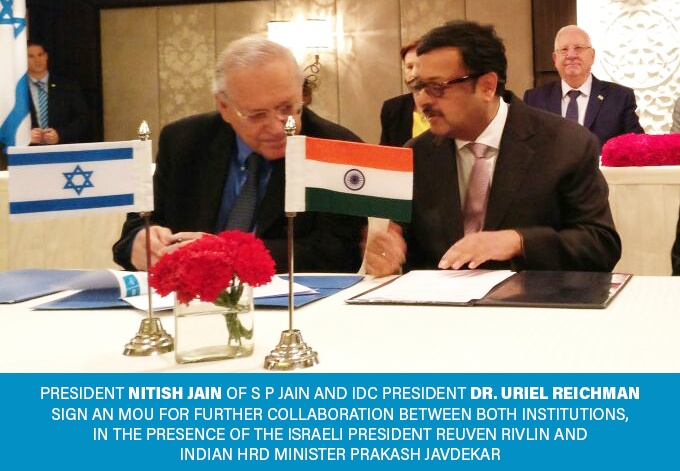
November 17, 2016: In a major step aimed at enhancing education and training in Cybersecurity, SP Jain School of High Technology (SPJ-HT) signed a Memorandum of Understanding (MoU) with Interdisciplinary Center (IDC) Herzliya, Israel.
Date: 17th November 2016
Date: 14th November 2016
Tags: Digital transformation
Date: 10th November 2016
Tags: Donald Trump, US Elections
TOLL-FREE NUMBER:
1800-212-1827
ABOUT US
SUBSCRIBE TO OUR NEWSLETTER
We’d love to share updates about our latest events with you. Sign up and get our newsletter delivered to your inbox.
© 2025 S P Jain School of Global Management
Name of PEl (Private Education Institution): S P Jain School of Global Management | Registered with Skills Future Singapore Agency (SSG) | PEI Registration Number: 200516544Z | Period of Registration: 09 May 2023 to 08 May 2029.
© 2025 S P Jain School of Global Management
S P Jain School of Global Management Pty. Ltd. CRICOS Provider Code: 03335G
© 2025 S P Jain School of Global Management
S P Jain School of Global Management Pty. Ltd. Provider Category: Institute of Higher Education. TEQSA Provider Identification: PRV12041. CRICOS Provider Code: 03335G.
S P Jain School of Global Management Pty. Ltd. CRICOS Provider Code: 03335G.
The summer program is not approved or attested by KHDA and does not result in an award accredited under the Australian Qualifications Framework.