



You have shortlisted a few MBA programs, started thinking about your future career and are ready to prepare for admissions. Then comes the question: which entrance exam should you take?
You have shortlisted a few MBA programs, started thinking about your future career and are ready to prepare for admissions. Then comes the question: which entrance exam should you take?
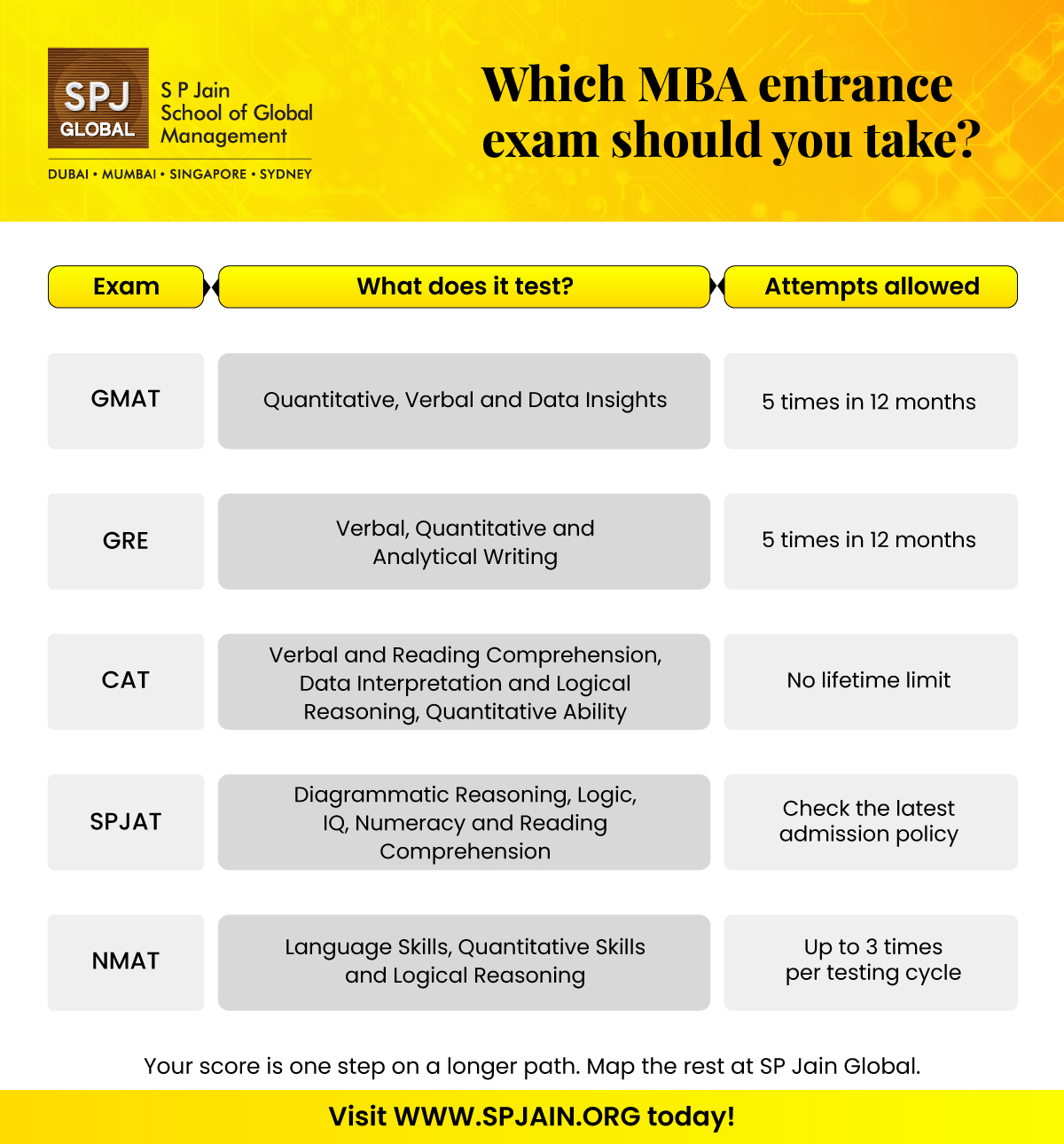
It matters more than it looks. The GMAT, GRE, CAT, SPJAT and NMAT each test different skills, follow different timelines and open different doors. Choosing between them requires more than comparing exam patterns or difficulty levels. Pick well, and your preparation works for you from day one. Or else, you could spend months training for a test that suits neither you nor your target schools.
This guide breaks down what each MBA entrance exam tests, who can take it, how long you may need to prepare, and which common mistakes can you avoid.
GMAT
The Graduate Management Admission Test (GMAT) is one of the most widely accepted entrance exams by business schools. It is a strong option if you are considering an MBA or a specialised business master's program, particularly at schools that accept GMAT scores internationally.
What does the GMAT assess?
The current GMAT consists of three sections:
- Quantitative Reasoning: Tests mathematical problem-solving using arithmetic and elementary algebra. You need to apply concepts accurately across accounting, finance, and managerial statistics.
- Verbal Reasoning: Assesses reading comprehension and critical reasoning, including your ability to evaluate arguments and draw conclusions.
- Data Insights: Tests your ability to interpret information from tables, graphs and multiple other sources. These skills are useful when evaluating business performance and making evidence-based decisions.
The exam lasts 2 hours and 15 minutes, with 64 questions across the three sections. Each section lasts 45 minutes.
Eligibility and number of attempts
You must generally be at least 18 to take the GMAT, subject to the test's policies. There is no universal undergraduate degree requirement to sit the exam, although your chosen business school will have its own admission criteria.
You can take the GMAT up to five times within a rolling 12-month period, with a minimum 16-day gap between attempts. There is no lifetime attempt limit. Scores remain valid for five years.
How should you prepare?
Allow approximately three to six months if you need to strengthen your fundamentals and build familiarity with the question formats. Your preparation may be shorter if you already have strong quantitative and verbal reasoning skills.
Begin with a diagnostic test, identify your weakest areas and practise under timed conditions. Review every incorrect answer to understand the reasoning behind the correct solution.
GRE
The Graduate Record Examination (GRE) is a general standardised admissions test accepted by many graduate schools, including business schools. It may suit you if you are considering management education alongside other postgraduate options.
What does the GRE assess?
The GRE General Test measures three key skill areas:
- Verbal Reasoning: Evaluates reading comprehension, vocabulary in context and the ability to interpret arguments.
- Quantitative Reasoning: Assesses mathematical reasoning involving arithmetic, algebra, geometry and data analysis.
- Analytical Writing: Tests your ability to construct a clear, reasoned argument in writing.
The current test takes approximately 1 hour and 58 minutes.
Eligibility and number of attempts
There is no universal undergraduate degree requirement to sit the GRE General Test. However, individual business schools determine their own academic and admissions requirements.
You can take the GRE once every 21 days, up to five times in any continuous 365-day period. Scores are generally valid for five years.
How should you prepare?
Plan for around two to four months, depending on your starting level. Vocabulary, reading comprehension and quantitative reasoning deserve consistent practice.
If you are comfortable with mathematics but struggle with complex reading passages, allocate more time to verbal exercises. Your preparation should reflect your actual performance rather than an assumption that every section requires equal effort.
CAT
The Common Admission Test (CAT) is one of India's principal entrance examinations for postgraduate management education programs in India. It is worth considering if you plan to pursue management education at institutions that accept CAT scores.
What does CAT assess?
CAT typically covers three sections:
- Verbal Ability and Reading Comprehension: Tests reading comprehension, sentence correction and verbal reasoning.
- Data Interpretation and Logical Reasoning: Assesses your ability to interpret data, identify patterns and solve structured reasoning problems.
- Quantitative Ability: Tests mathematical concepts, including arithmetic, algebra and geometry.
The exam is designed to assess how effectively you solve problems under time pressure. Strong preparation requires both conceptual understanding and the ability to choose an efficient approach.
Eligibility and number of attempts
Candidates generally need a bachelor's degree with at least 50% marks or equivalent CGPA. The minimum is 45% for candidates belonging to the reserved categories. Final-year undergraduate students may also apply, subject to the applicable rules.
CAT is conducted annually, and there is no fixed lifetime limit on the number of attempts. You must register and meet the eligibility requirements for the relevant examination cycle.
How should you prepare?
A preparation period of six to nine months can be useful, particularly if you are balancing CAT with college or work. Start by strengthening mathematical fundamentals, reading regularly and practising logical reasoning.
As the exam approaches, take timed mock tests and analyse your performance. A high number of practice questions is less valuable than understanding why you lose marks and correcting those weaknesses.
SPJAT
The SP Jain Aptitude Test (SPJAT) is an online aptitude test used in the admissions process for selected postgraduate management programs at SP Jain Global.
It suits graduates from any discipline who want an efficient route into SP Jain Global programs and need an alternative to other accepted entrance examinations.
What does SPJAT assess?
SPJAT evaluates five areas:
- Diagrammatic Reasoning: Tests your ability to interpret visual patterns and relationships.
- Logic: Assesses how you identify connections and draw conclusions.
- IQ: Evaluates general reasoning and problem-solving ability.
- Numeracy: Tests mathematical aptitude and numerical reasoning.
- Reading Comprehension: Measures your ability to understand and interpret written information.
The published postgraduate test format includes up to 34 questions and a maximum score of 100. The test is online, and there are no sectional cut-offs. The overall score must meet the applicable requirement.
Eligibility and number of attempts
SPJAT is an admissions assessment rather than a standalone qualification. You must meet the academic and other entry requirements of your chosen program. Check the latest test and admission policies before scheduling your attempt.
How should you prepare?
Allow approximately four to six weeks for focused preparation if you already have sound mathematical and verbal fundamentals. You may need longer if these skills require development.
Practise sample papers, work on numerical accuracy and familiarise yourself with diagrammatic and logical reasoning questions. Timed practice is particularly useful because it helps you make decisions without spending too long on individual questions.
NMAT
The NMAT by GMAC exam is a computer-based entrance test accepted by participating business schools in India and selected institutions elsewhere.
Its section structure and retake policy may appeal to applicants who want opportunities to improve their performance within the examination cycle.
What does NMAT assess?
The test contains three sections:
- Language Skills: Assesses reading comprehension, grammar, vocabulary and sentence structure.
- Quantitative Skills: Tests arithmetic, algebra, probability and data interpretation.
- Logical Reasoning: Evaluates critical reasoning, analytical puzzles, deductions and decision-making.
The exam contains 108 questions and takes 120 minutes. Each section is individually timed, and you can choose the order of the sections.
Eligibility and number of attempts
As a candidate, you may need a bachelor's degree with at least 50% marks or equivalent CGPA. Check the academic qualifications and other criteria set by your target institutions.
You can take NMAT up to three times in a testing cycle, including your first attempt and two retakes. A minimum seven-day gap applies between eligible attempts.
However, do not assume every school will consider your best score. Some institutions may have different policies regarding repeat attempts.
How should you prepare?
Around six to eight weeks may be sufficient if your fundamentals are strong. Otherwise, allow two to three months to improve your accuracy and speed.
Practise each section within its individual time limit. Because you cannot transfer unused time between sections, your ability to pace yourself is just as important as knowing the concepts.
How can you choose the right MBA entrance exam?
- Check your target schools: Identify which entrance exams your preferred business schools accept.
- Assess your strengths: Choose a test that aligns with your quantitative, verbal and logical reasoning skills.
- Consider your career goals: Select an exam that supports your plans to study in India or overseas.
- Evaluate preparation time: Match the exam requirements with your current skills and available study time.
- Compare costs and deadlines: Review registration fees, score validity, retake policies and application deadlines.
How many exams should you attempt?
For most applicants, preparing seriously for one or two exams is practical. Registering for every available test in one year rarely helps, as each one asks for a different kind of preparation, and your scores tend to suffer. Choose one primary exam that covers most of your target schools. Consider a second exam if it opens meaningful additional options and the preparation overlaps with your existing study plan. For example, if SPJAT is an option for your chosen SP Jain Global postgraduate program, assess its preparation requirements before adding another test.
Remember that more scores do not automatically make your application stronger. Your time may be better spent improving one result and preparing a thoughtful application.
Common preparation mistakes that can cost you valuable time
- Starting without a baseline assessment: Take a diagnostic test before building your study schedule. This helps you allocate time to the areas that need the most work.
- Ignoring timed practice: Knowing how to solve a question is different from solving it accurately under exam conditions. Use mock tests to develop both speed and judgement.
- Relying on your overall score alone: Some schools consider individual section performance or use additional selection criteria. Understand how your target institutions assess applicants.
- Treating the entrance exam as the entire admissions process: Your score is only one part of your application. Academic records, work experience, essays, case discussions and interviews may also influence the final decision.
Your next step
The best MBA entrance exam is the one that matches your goals and gives you a fair shot at your best score. Pick it early, and you give yourself time to prepare well.
Ready to see where your score could take you? Read through the admissions criteria for SP Jain Global’s postgraduate programs and build your exam plan around the path you want to take.
Recommended reads:
Where should you study your MBA in 2027? Four global cities that can shape your career
Global MBA vs. MBA in India: Which one is right for your career?
Can you do an MBA while working full time? A practical guide to work-life balance