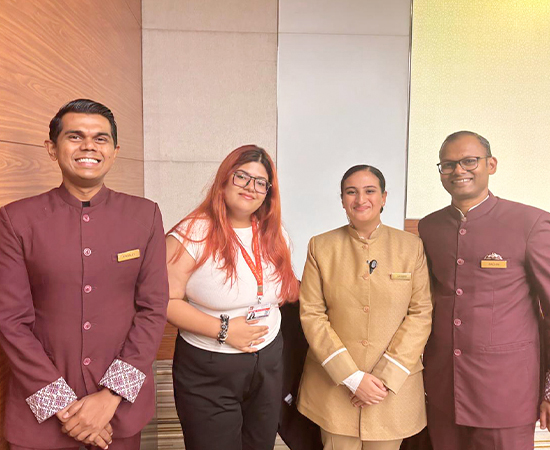


I entered the Design Thinking Exhibition expecting a presentation, but left with a deeper lesson — real problem-solving begins with understanding people.
I entered the Design Thinking Exhibition expecting a presentation, but left with a deeper lesson — real problem-solving begins with understanding people.
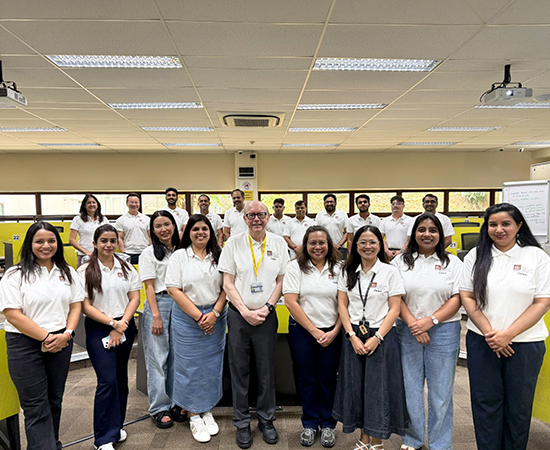
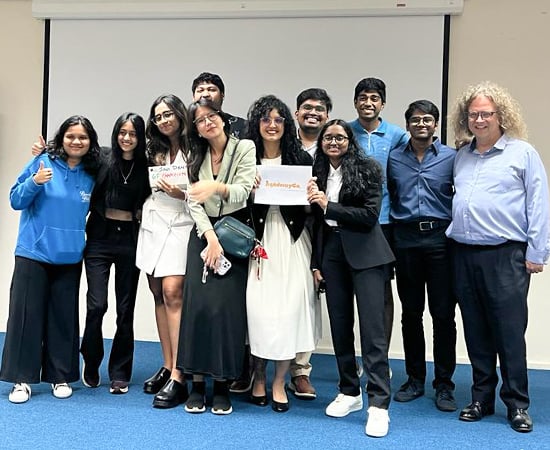
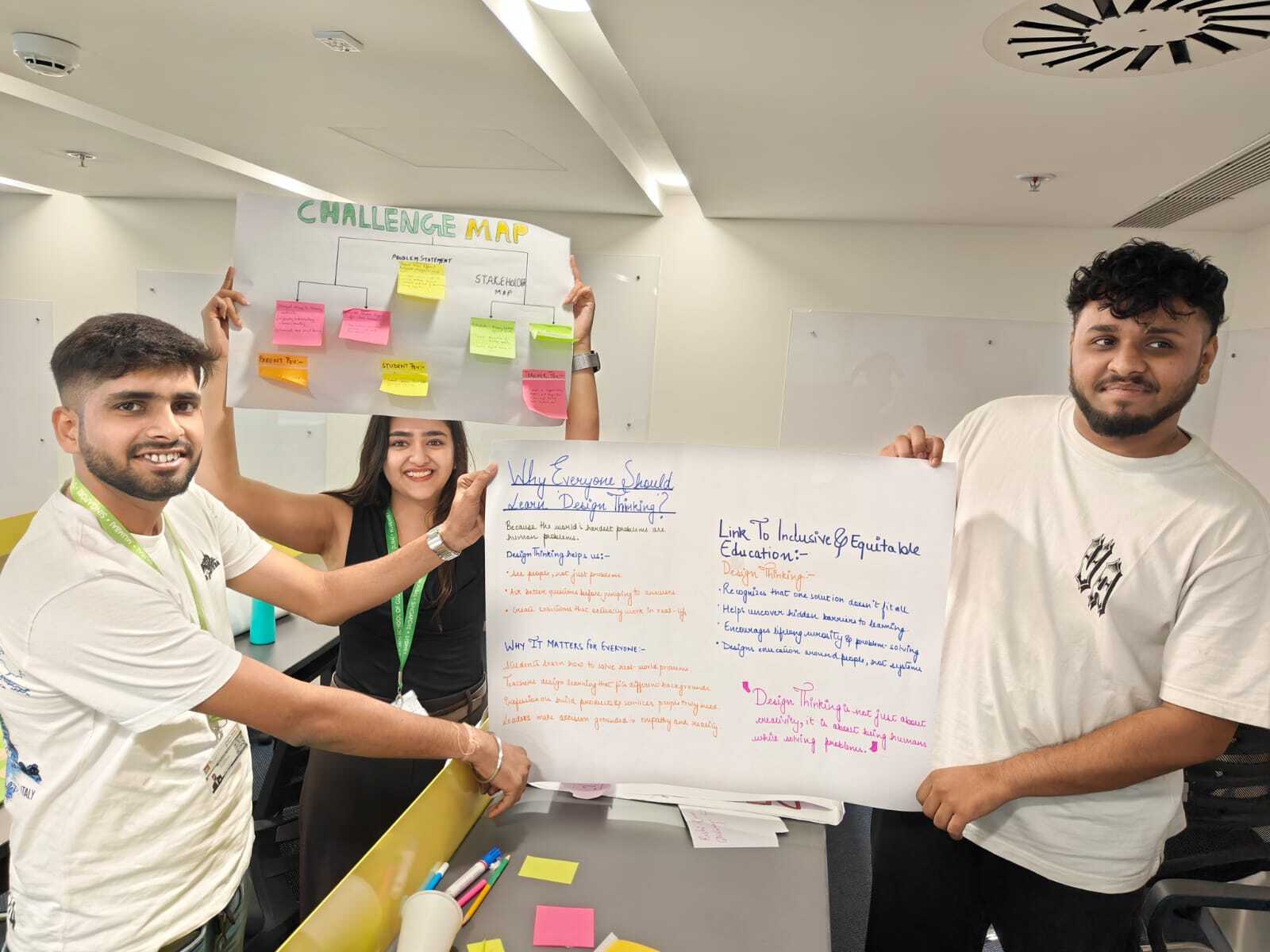
For our Design Thinking subject with Prof. Kanti Kovvali, we organised an exhibition with a simple but ambitious objective: to make Design Thinking feel real. Not as a definition to memorise, but as a way of working, you could see, question, and experience.
It wasn’t about remembering a process.
It was about experiencing a mindset: curiosity over certainty, empathy over assumptions, and learning over looking smart.
The exhibition: Making thinking visible
Each group worked on a different real-world theme and built a mini-world around it. Despite the variety, every stall carried the same underlying mission:
- Explain what Design Thinking is
- Show why it’s different
- And demonstrate why it matters for everyone — not just “creative people”
The format forced clarity.
There was no hiding behind jargon. No empty “framework talk.” We had to communicate through visuals, stories, and interaction in ways that made people stop, ask questions, and engage.
There were six groups, each addressing a distinct theme:
- Redesigning Education for a Future-Ready Workforce
- Quality Education
- A Safe, Respectful, and Unbiased Workplace for Women
- Reducing Panic and Responding Calmly During Climate-Related Disasters
- Ensuring Healthy Lives and Promoting Well-Being for All Ages
- Responsible Consumption and Production
Our group’s theme was Quality Education.
An idea so familiar that it risks becoming background noise. Everyone supports it in theory. But in a country like India, quality education isn’t a slogan. It’s a daily negotiation between potential and circumstance, between a child’s curiosity and the system’s capacity to hold it.
To ground ourselves in reality, we visited NM Joshi Government School.
I didn’t walk in expecting a dramatic contrast. I walked in expecting nuance. And that’s exactly what we found.
.jpeg?width=480&height=640&name=Aishwarya-Goel-GCGM-student-experience-SP-Jain-Global%20(4).jpeg)
.jpeg?width=480&height=640&name=Aishwarya-Goel-GCGM-student-experience-SP-Jain-Global%20(3).jpeg)
What the classroom taught us
The infrastructure constraints were real. But what stayed with me? — It was what the students carried anyway.
There was a readiness to participate, to be seen, to try. The classroom had its limitations, but the energy inside it didn’t feel like resignation. It felt like an effort.
The teaching styles were structured and sincere. The students were responsive, yet you could sense the invisible weight some of them carried. Language shaped confidence in ways we don’t always acknowledge. A child could know an answer and still hesitate to say it — because knowing and speaking are not the same skill.
Engagement wasn’t absent. It was uneven. Often determined by how safe a student felt being wrong.
And the teachers, more than anything, felt like the backbone of the entire ecosystem. Committed. Present. Stretched. Not because they didn’t care, but because there’s only so much one person can personalise when the room is full, and learning levels are wide.
That visit quietly rewired our thinking.
We began to see that motivation often exists long before exposure does.
That a child’s pace isn’t a measure of intelligence — it’s a measure of context.
That quality education isn’t only about buildings, boards, or curriculum.
It’s also about confidence.
HLL (Heart—Logic—Long-term vision) Framework with intent
In our project, we used the HLL Framework not as a fancy label, but as a way to stay honest.
- Heart: Because you can’t design for children if you only look at marks and outcomes. You have to understand what it feels like to sit in a classroom where learning moves faster than your comprehension, and asking again feels like announcing your weakness.
- Logic: We identified a core gap. One-size-fits-all teaching doesn’t just fail slower learners — it quietly bores faster learners. In both cases, confidence takes a hit.
- Long-Term Vision: What would learning look like if progression felt like dignity, not pressure?
.jpeg?width=480&height=640&name=Aishwarya-Goel-GCGM-student-experience-SP-Jain-Global%20(2).jpeg)
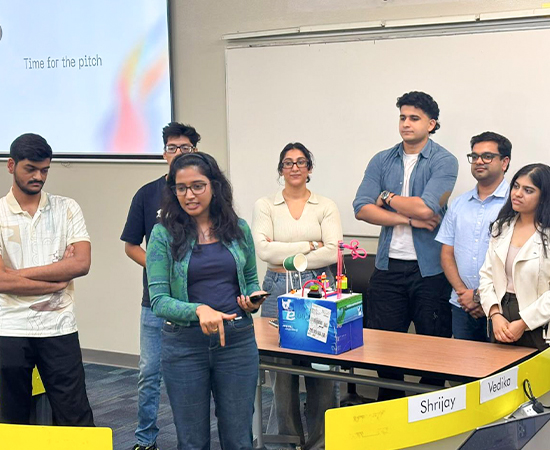
That’s how our prototype took shape.
We created three books: Easy, Medium, and Hard. Not to label children, but to meet them where they are.
The idea was simple: learning should feel like climbing steps, not being thrown into deep water. A child could start at a level that matches their current comfort and move upward gradually — building skill and self-belief together.
Progress becomes visible. Effort feels rewarded. And most importantly, children stop internalising the idea that they are “behind.”
They are simply on a different step of the same ladder.
The Exhibition made me realise something I hadn’t fully appreciated before. Design Thinking doesn’t just produce solutions. It produces a shift in posture.
You stop treating people like “users” and start seeing them as lived stories. You stop assuming the problem is obvious. You start asking what’s happening beneath the surface.
And if there’s one takeaway I’m carrying forward, it’s this: The most meaningful innovations are not the ones that impress. They’re the ones that restore dignity.
Because when you design education with empathy, you’re not just building better students.
You’re building braver humans.
.jpeg?width=480&height=360&name=Aishwarya-Goel-GCGM-student-experience-SP-Jain-Global%20(1).jpeg)
About the author:
Aishwarya Goel is pursuing the GCGM program at SP Jain Global. Before the MBA, she worked as a Senior Copywriter in advertising with 4+ years of experience, where her role centred on shaping brand stories and campaign communication.
Recommended Reads:
- Where education meets impact: A journey of leadership, social responsibility, and purpose
- My Executive MBA Dubai Intensive Experience with Dr Gary Stockport
- My BBA classroom without walls: A global learning experience
- A transformative journey: My DBA experience at SP Jain School of Global Management, Sydney