


I picked SP Jain Global for two reasons that sounded good on paper: the international exposure and the promise that business schooling here wouldn't just live inside a textbook. What I didn't put into words back then—not even to myself—was how nervous I actually was. A new city, new people, and a curriculum that jumps continents every year. I remember sitting on the flight to Mumbai wondering if I'd packed the wrong version of confidence.
I picked SP Jain Global for two reasons that sounded good on paper: the international exposure and the promise that business schooling here wouldn't just live inside a textbook. What I didn't put into words back then—not even to myself—was how nervous I actually was. A new city, new people, and a curriculum that jumps continents every year. I remember sitting on the flight to Mumbai wondering if I'd packed the wrong version of confidence.
A year later, as I get ready to move to Dubai, I keep thinking about how little of what changed in me happened in a classroom.
Learning beyond the classroom
Mumbai doesn't really let you sit still. You feel it the second you step outside: the traffic that never fully stops, the local trains packed shoulder to shoulder, and the way every second shop is somebody's hustle. That energy leaked into everything we studied. A marketing lecture wasn't really about the four Ps; it was about arguing over why a D2C brand's Instagram ad worked and a legacy company's didn't. Business communication stopped being about clean PowerPoint slides and started being about the very specific art of saying something to a room that's half checked out on their phones without losing them completely.
What got me, more than any single class, was how the city and the coursework kept bleeding into each other. We'd start a lecture on a strategy framework and somehow end up dissecting a company that was in the news that same morning. Finance, retail, logistics, media—it stopped feeling like separate subjects and started feeling like one very loud, very chaotic conversation that Mumbai was having with itself, and we just happened to be sitting in on it.
Lessons that didn't come from a textbook
Some of the best learning didn't happen during scheduled class time at all. I remember a company visit where a founder admitted, almost offhandedly, that their first product had failed so badly they'd nearly shut down within six months of launch, and how much more that stuck with me than any case study ever could. Guest speakers were at their best when they weren't polished, when they talked about a decision they still weren't sure was right. And our debate sessions taught me something I didn't expect: the people who "won" weren't the loudest in the room. They were the ones who'd actually listened to the other side long enough to find the weak point in it.
When theory met reality
All of this became a lot less theoretical once I started interning at RecruitKar, an AI-powered hiring platform, as a Sales and Marketing Intern. Suddenly, the frameworks had to survive contact with an actual client on the other end of a call who didn't care about my slide deck, only whether I understood their hiring problem. I learned fast that consumer behaviour isn't a chapter—it's the difference between a client hanging up on you and a client actually listening. I also learned, the harder way, that being good at talking is not the same as being good at selling. Selling is mostly listening with intent.
Leadership, culture, and the small things that matter
The internship taught me things no syllabus could. I noticed how much of a workplace's mood comes from one person. The founder of the company didn't just hand out tasks; he set the emotional temperature of the whole team without saying a word about it. I started paying attention to the small stuff: who got credit in meetings, how disagreements were handled, and whether people said what they actually meant. It made me quietly promise myself that if I ever run a team, I'll care as much about how people feel on a Tuesday afternoon as I do about the quarterly numbers.
The quiet build-up of confidence
If I'm honest, there wasn't one big cinematic moment where I "became" more confident. Nobody hands you a certificate for that. It happened in smaller, almost embarrassing ways: the first time I pushed back on a client's assumption instead of just nodding along, the first group project where I said, "I disagree," out loud in a room full of people I still felt slightly intimidated by, and the first time I caught myself staying calm during a deadline crunch instead of spiralling about it at 1 a.m.
Somewhere in the middle of all that—the assignments, the internship calls, the group projects that ran until midnight, and the city that refused to slow down for any of it—I stopped treating every hard moment as proof I didn't belong here. I started treating it as proof that I was actually doing the thing I came here to do.
Redefining success
I also learned to watch myself a little more honestly. Not in a self-obsessed way, just paying attention. How I acted under pressure. How differently I communicated with someone who thought nothing like me. How my own definition of "doing well" quietly shifted from grades to something harder to put on a resume: whether I was becoming someone more comfortable with not having all the answers yet.
Looking ahead to Dubai
I'm packing for Dubai now, and it's a strange kind of packing: half suitcase, half everything I picked up this year that doesn't fold. I know there's another unfamiliar city waiting, another set of people I haven't met yet, and another version of me I haven't run into. A year ago, that sentence would have scared me. Right now, it just feels like the next chapter of the same story, and I'm genuinely curious how it ends.
Growth happens quietly
If there's one thing my first year taught me, it's this: growth rarely shows up when you're looking for it. It shows up in the ordinary stuff—a client call, a debate you almost lost, a train ride home you were too tired to notice. And then one day, you look back and realise the person you were twelve months ago would be quietly proud of who you're turning into.
About the author:
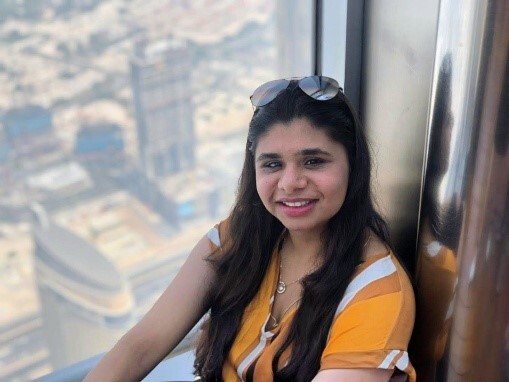
Shruti Srivastava is our Business Management Program (BMP)* student currently preparing for her next term in Dubai.
Learn more about the BMP program here
Recommended reads:
A BBA student’s journey of growth and leadership


.jpg)